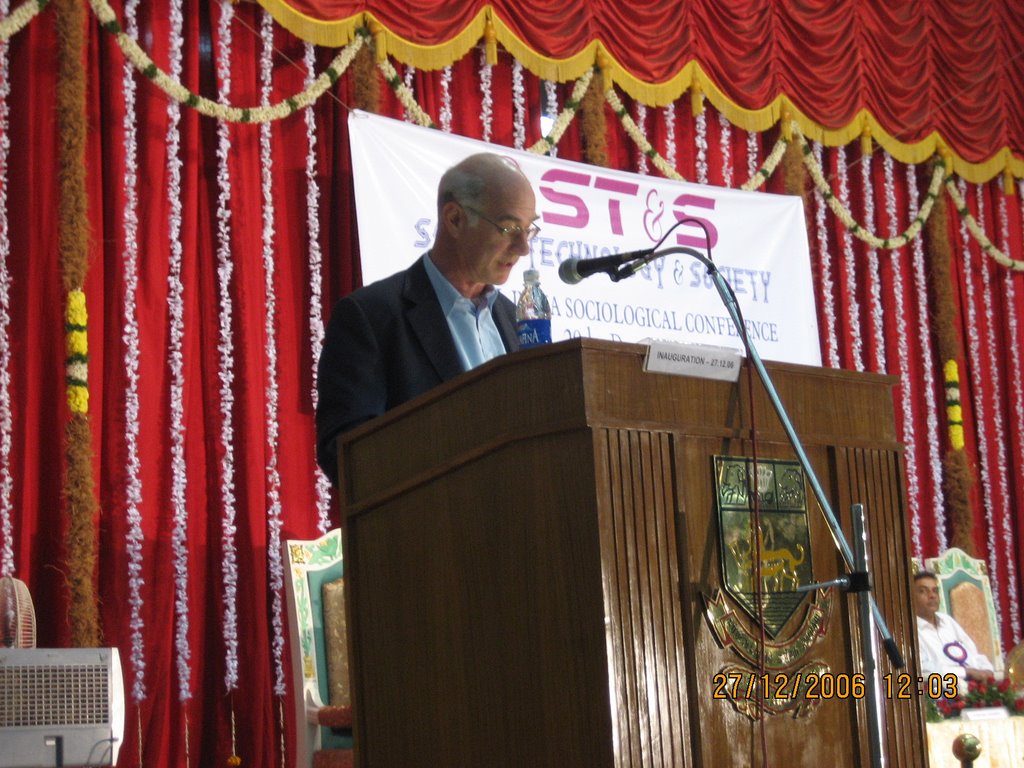
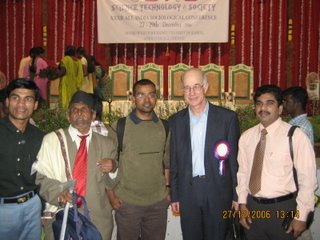
Address of Prof Michael Burawoy (Vice-President, American Sociological Association)at the XXXII All India Sociological Conference at Chennai on Public Sociology during 27 - 29 December 2006
Forty years ago, when I was a very young undergraduate in England, I actually came to India. That was the last time I have been here. Forty years ago. I have a confession that I came on a mission. I believe in those days, it was 1967; there was a time of great upsurge in many parts of the world particularly among the students. And I believe in that time education was the key to the freedom and emancipation of the world and I feel I am committed to that idea though hopefully a little less naively than I was in 1967. I came here in 1967 as an under graduate at the age of 18 or 20 to study the medium of instruction in university education. I do not know how I managed to figure out why that was an obsession of mine but I thought this will be an interesting issue to study.
It was my summer holidays and I was here for four months. I went around the country. I was in the University of Cambridge and there were number of people who had been involved in education there – Indian education, higher education – and they thought that this was an interesting project for me in the summer. So what I did? I am really very embarrassed to be saying this but I have a reason. What I did – I decided is that this was a technical problem whether to have a medium of education in English or Hindi or in a regional language. I believe that the issues have not quite been resolved yet. Nevertheless, in those days what I thought that to go around the country and to get people to translate a comprehensive test/ passage on development theory into regional languages. I go to a class and divide the 200 students and give them a comprehensive passage and see how well they did. I thought this was a technical problem. But you know there was a real answer to this question. What language one should have as the medium of instruction? I was very very naïve and it is humiliating to me forty years later to tell you this. But it does present a particular perspective – a narrow technical perspective on sociology. I believe what I learnt then was that, of course, the medium of higher education in India is not a “technical issue” but a “political issue”. I learnt that very quickly. I was in Madras Christian College, I was in Lucknow, I was in Gujarat, and I was in Bombay. Those are the various places I visited and I quickly learnt that the technical educational issue was actually a political issue. And that was my sociological education. So I am here today to THANK YOU for making me a SOCIOLOGIST. I was to born as a sociologist to recognize the technical issues or actually the public issues or the political issues. That was the fundamental sociological question that we cannot look at educational issues in a fundamentally technical composition. One has to go broader and think about the various interests – whether the interests in careers, in state, in politics of the regional state or whether the interest was in caste. This is what I learnt here in India.
Well, I became a SOCIOLOGIST here in INDIA and I am here to report back a little bit about what has happened to me and to give you my perspective. I am now a Sociologist in the USA, though I spend a lot of time different parts of the World. I will give you some perspective on sociology.
So, what happened to me after 1967? Actually I was a Mathematics Undergraduate. So I really did not know a lot of Sociology. I became a SOCIAL ANTHROPOLOGIST – an animal that is quite familiar to you in this country. I became an ETHNOGRAPHER, a participant observer in many parts of the World in different industries. I became an unskilled, semi-skilled operator in different parts of the World. I began my INDUSTRIAL SOCIOLOGY in a place called ZAMBIA in Africa. I came there in 1968 ad left in 1972. It was the immediate post-colonial years. I was studying what? I was studying the Copper industry and the way in which the Copper industry was responding to independence – these Multinational Corporations – how are they responding to the independence of Zambia. I was particularly interested in the way in which “race” and “class” interweaved in that period. I did the study from 1968 to 1972 and after I left things have really gone bad. The price of Copper fell and fell during the 1970s and then came the IMF and the World Bank with the Structural Adjustment Programmes. And the result was that the host society declined – both rural and urban populations. That was my ‘First Aftermath’.
The ‘Second Aftermath’ or the second project I undertook is to take up a Ph.D degree in University of Chicago where I met my friend Anand Kumar. He came a little bit after me when I was leaving. Here I studied the industrial working class in South Chicago. 1973-74 – there I began to understand the development of a particular form of what I call the ‘hegemonic industrial relations’ – whether that coordinative class compromise between workers and managers. It was the height of fact of trade union organizations in Industrial sector. What happened after 1973-74? After I left, – decline. What happened in South Chicago was deindustrialization, manufacturing companies moved out and the South Chicago became an Industrial Wasteland. Trade Union movement has declined in USA in 1973-74. Secular decline. Well, that was Chicago.
So, then I thought I need to think more about the non-capitalist societies because lot of my arguments are about capitalist character of production and labour. So I thought I should go to a non-capitalist society. I was very intrigued to go to POLAND to the Solidarity movement which was of course the first and last societal wide movement of the working class. And I thought it was very strange as it was happening in a society which I call ‘State Socialist Society’ not a capitalist one. You Academics are very slow. We take a lot of time to catch up with the events in the World. By the time I got my bags together, by the time I began to learn Polish, there was a coup. Yarozoski took over power. Solidarity was repressed. Even though it lasted for 13 months, I never made it to Poland. Well, I made to the next best place which is HUNGARY where I also became worker in many factories. I had a good time in Champaign factory. I do not know how many of you worked in Champaign factory here. But they can be lot of fun. We never drunk Champaign; we only drunk beer. But anyway I worked in many factories in Hungary. I was trying to understand the characteristics of the working class – why Poland had developed a radical working class revolution and Hungary has not? What was the character of socialist work organization? So I was working in many factories and living with the working class. And I did this for a period of from 1982-83 to 1989. Actually I was also a member of the October Revolution Socialist Brigade. Very proud of that. But anyway I was working there on and off. What I did not notice was that the Hungarian Political Structure was crumbling and disappeared. In fact, it was overthrown in 1989 in those transformations that swept across Eastern Europe. So I thought well I did not come to Hungary to study the transition from socialist to the capitalism. I did not come to Hungary to study the development of market economy. I came to Hungary to study the “democratization of socialism”. So I decided to go to the last, in that part of the World, the socialist society still existing which was then SOVIET UNION. So I went there in 1990-91. As you know Eastern Europe made this market transition and in Eastern Europe this has been a sad story. Fellow workers in the October revolution Socialist brigade are now with or without a job or subject to degradation. In fact Hungary was fast catching up with the wasteland of South Chicago. This became again another industrial wasteland.
So I moved on the RUSSIA. And you know, it was only a few months. I was working in a furniture factory. I stopped in July and in August there was this attempting coup that failed and in December what would have happened? The Soviet Union disintegrated. So I have been two or three years of watching the systematic decline of the Soviet Society was subject to a radical shock therapy intervention of marketization and privatization. My friends say you are not going anywhere else. They blame me for these catastrophes. I as a Sociologist do not blame myself. I do not think I am such a heroic person.
So, I believe what is common to all these four experience – Zambia, South Chicago, Hungary and Russia – is the aftermath that I left behind is the “marketization”. Everywhere marketization has disrupted and destroyed what was industrial society. I believe we are in a period of what I call “third wave marketization” and I do not think that India has escaped it either. If I imagine what Chennai was forty years ago and I think today we see the power of markets – positive and negative in this very city. For me to begin to think about the significance of third wave marketization for sociology, I have drawn from the works of Karl Polanyi. I do not know whether he is a familiar writer to you here in India but in the United State and in Europe he has become an icon of a “critical sociology” – a sociology that is critical of market fundamentalism sometimes known as neo-liberalism. Karl Polanyi lived from 1886 to 1964, actually very identical years to the life of Nehru. Polanyi was originally born in Hungary and his work has come to be known for its critical assessment of the development of the markets. He has two theses –
1. One thesis is that for markets to succeed, for markets actually to develop, they have to be embedded in social relationships in society and the danger is that when markets destroy society and destroy the state that necessary to keep markets going then they lead to major catastrophe.
2. The second argument is that the markets not only need society but also generate what he calls “counter movements”. Where markets develop, they develop reactions from society that try and contain and constrain markets.
It is this later argument that use to develop my understanding of the relationship between the third wave marketization and sociology. Karl Polanyi wrote the book called The Great Transformation that is his one single most important canonical work in 1944. He was obsessed about the rise of Fascism and Stalinist Communism in the World that time but also the outbreak of the First and Second World Wars. He put the blame on markets. He said that market fundamentalism that push the argument that markets are so generating and self-reproducing had led to such as severe reaction that Fascism and Communism as a response or a particular form of coercive communism. He thought that there would never be another wave of market fundamentalism. He could not anticipate it and his vision of the future was very much of a market embedded in society – a market was in fact actually a responsive to a collective self-organization of civil society and the state. He could not imagine the World as we know it today.
Marketization is spreading everywhere. Let me outline briefly how to understand third wave marketization historically and to some extent geographically and I want to draw upon the ideas of Karl Polanyi particularly his most central idea – the idea of a ‘Fictitious Commodity’. A fictitious commodity is a commodity that when it is exchanged it loses its use value. So we have three fictitious commodities – labour, money and environment or land. He calls it land and I am going to call it environment or you may call it the nature. What he meant when he called LABOUR a fictitious commodity? It’s when labour or the workers sell their labour power and are easily fired and hired by the will of capital, they loose their capacity to generate productively production. They loose their use value. Labour has no longer become productive when they are subject to tyrannical laws of the market. Equally when MONEY is subject to arbitrary exchange, it looses its capacity as a medium of exchange. And when LAND is subject to commodification and exchange, it is degraded and actually threatens the existence of humanity. These are the three main Fictitious Commodities. Though he did not put it in chronological order, I would suggest to you that there three waves of marketization each corresponding to a new fictitious commodity.
The First Wave of Marketization broadly we might say is the 18th century and we are particularly talking about Europe though colonies were also involve in this. And the commodity that was fictitious, that was subject to exchange and which generated a reaction or a counter movement was indeed labour. The Second Wave, I would put, What Hobsbawm calls “the Short Twentieth Century” – that is between the First World War and I am going to put it till 1973. What happens in that Second Wave of Marketization is that markets developed in the 1920s and 30s through out the World and there is a reaction by the Nation-States to protect them-selves from this International trade? Countries stood as obstacle that the money is no longer freely exchange in the international arena. So states begin to develop a regulated economy – “organized capitalism”. And we associate this with Fascism – very much the idea of an organized Market economy; Communism – in 1920s in Soviet Union the market was very much in the advance but in the 1930s collectivization came and planning came and this is a reaction like in other countries and this is a specific reaction to marketization. In the United States, we have the new deal and in Europe we had Social Democracy – these emerged as a response to commodification of money in the international arena – the protective policies of the States. This Second Wave leading to a reactionist Nation-State. If the First Wave marketization reaction to the commodification of labour is local and union organizing; the Second Wave of Marketization is the building up of Nation-States that regulate economy. The Third Wave Marketization in my view is a period in which we have distinctitively the commodification of environment. This is the new commodity. Yes there was the commodification of land before the present period from 1973 onwards. But I think the struggles, the movements and the responses of the third wave marketization of those that are responsive to the commodification of the environment. What do I mean?
Well, we have all sorts of struggles around the privatization of water problem – whether be here, whether be China, whether be South Africa or whether be Latin America. Struggles around land privatization and that actually is going on in the United States and hurricane Katrina is an emblematic example of how environment could be commodified and sometime how the state sometimes is incapable of responding to that commodification. I think the environment has become the signal focus of the social movements and I also believe that those social movements can not be nation-based. They have to be globally based. They will be stitched together across national boundaries and there is evidence indeed that the environmental movements are engaged precisely in that stitching process because they are responding to so similar processes under the third wave marketization – the commodification of the basic means of existence – land, water and air.
What I want to suggest is that associated with each marketization wave is a particular set of rights – labour rights for first wave marketization and social rights. What I mean by labor rights is basically the protection of labour – the limitation of the length of the working day, minimum wages, trade union representation – those are labour rights. Social rights are all those we call welfare rights. They are rights protect the reproduction of labour power, the maintenance of our existence beyond the work place. So they involve the all kinds of insurance schemes, involves education, pensions, children support, etc. Such things entail social rights and they appeared as a response to second wave of marketization. Then we come to what I call human rights which is a response to the third wave of marketization. I think talking about human rights is the existence and the continued existence of human life that is what is stated here. When people are have their means of existence expropriated from them. Human right is the right that we collectively organize to recognize one another. Of course it is very controversial to talk about human rights. For some it is a new form of Western imperialism. In fact human right is often referred as the extension of liberal democracy. Other people say human right is the extension of the freedom of choice in the market. I am arguing that human right is actually is the capacity we have to organize collectively in society. This is very closely tied to the project of SOCIOLOGY.
Well, anyway, I believe that there is a struggle taking place in the World about the very meaning of human rights and we sociologist have an interest in participating in that struggle defining human rights in relation to the constitution of civil society and human existence. Well that is the beginning and let me just suggest you the connection between these three waves of marketization to sociology. Well there are three waves of Sociology and we are, I argue, in the third wave. The First Wave is the 19th century “Utopian Sociology” – utopian society is the reaction to the commodification of labour. Very prevalent in the United States, very prevalent in England. Many say Marx was utopian. I would argue Durkheim was utopian. Weber of course was not. You might argue, I do not know, that perhaps a little later of periodization Gandhi represents a utopian movement in social thinking in this country.
The Second Wave responses connected to the Social rights of the State. Social rights defended by the state and what I call “Policy Sociology”. Policy sociology is that sociology in which the state defines a set of problems and we social scientists then have to watch. We have to solve those problems. Usually the problems are already solved and we just exist the legitimize solutions are already been given by our clients – politicians. Policy sociology, I believe, was strongly grounded in the United States after the First World War. Funding came from foundations, funding came from the federal government and out of that came sociology. Sociology was very much connected to policy issues. Social problems were defined in policy terms.
We now then come to the third wave marketization and the Third Wave of Sociology. We come to what I call “Public Sociology” and I am known in the United States as the evangelist of the public sociology. What is this public sociology? It is that sociology which recognizes that states and markets are in such tight collusion that there is little space within the state for sociology to act out on the interests of society. In the third wave, their immediate and important audience is “the publics”. They are founded on civil society. We sociologists engage in a dialogue between publics and ourselves. Publics and ourselves in dialogue are endow the basic values in society. How we can collectively organize to move forward in realizing these values? A public sociology is not like here is a problem and here is the solution; it is a dialogic relationship, it is conversation between sociologists and publics. That is public sociology and of course there are many publics and therefore many-sociologies. And when American sociologists often complain about the fragmentation of sociology? I argue that it has to be fragmented because there are different publics and there are different sociologies. There is an overarching vision of sociology –public sociology. We have to engage different publics and therefore we develop different research programmes.
So now I come to the form of science associated with these forms of sociology. The utopian sociology had a very speculative science and it talked in the idiom of Comte and Spenser but they did not really do any empirical work. That was really the positivist. We are really concerned with solving problems and empirical work, real empirical research really took off under the second wave of marketization and sociology. And the third wave is the reflexive sociology. What we do in the reflexive sociology is that we bring back the centrality of values, the moral concerns, the power in the first wave and bind them together with the science developed in the second wave and we have these multiple research programmes which are self-consciously based on values. We are not into value-free sociology; we are into value-based sociology. But it is still a science; a value-based science. I call it a reflexive sociology.
Finally, let me put a geographical spin on this table. I think that the impetus for the first wave sociology was indeed in Europe – England, France and Germany. I think the impetus for the second wave policy sociology was really the United States. It was really the USA sociology that the professionalization of sociology – the commitment to careful empirical analysis – happened in the United States. Public sociology will have its impetus not in United States, not in Europe but in the Semi-periphery. As I travel around the world, I see public sociology is most vibrant in places like South Africa, in places like Brazil. In fact, in Iran, it becomes a very interesting case in terms of public sociology; Portugal is a very interesting place; in China, they have aspirations for public sociology. They really grabbed on this idea of public sociology. But they first have to build their civil society on which they can rest their public sociology. And I leave it to you whether Public Sociology is in upsurge here in India. But I warn you, there are two types of public sociologies – the traditional and the organic. The traditional public sociology is something in which someone writes something in opinion pieces of the newspaper and writes widely, selling books and everybody reads it and discuss it. Very important. But there is another type of public sociology – a sociology which is intimately committed to concern with in relation with smaller, thicker and sometimes more active publics. They are invisible. You will not see them in newspapers. They are doing invisible works. My experience in the United States, but in many colleges in state system not in the elite system, they are still in the second wave. But in the smaller universities, there you find sociologists who are in engaged in building dialogues and movements. It is my vision for public sociologies that it will be very global, it will be concerned about environmental issues and human rights and it will emanate from countries such as this that are subject to great transformations in society. They still have a committed body of sociologists and I notice yesterday when I heard the young sociologists; I notice how they are all budding public sociologists.

So, let me just conclude. My conclusion is a qualification of what I have to say about what I have just said.
1. The movement from one wave to the next is what I call ‘dialectical progression’. I gave a similar talk in Hong Kong and they said No, No. This is ‘dialectical regression’. No, this is dialectical progression. What I am saying is that each wave absorbs features of the previous wave. The issues of the first wave and the second wave do not disappear in the third wave. They are still there and we are still organizing around the issues of labour and social rights. The environmental issues are important but do not exclude the issues of labour movements and issues of social rights. Equally, reflexive sociology abandons the moral concern of the first wave. In fact it articulated the moral concerns of the first wave and empirical concerns of the second wave and brings them together in this reflexive sociology. Again it is a dialectical progression. Again the same way this does not mean that the whole public sociology is coming from the semi-periphery, I do not believe that the United States would be just forgotten. There is sociology there – professional sociology – and I believe that it will contribute to the public sociology and I believe that there are a lot of public sociology there. But the imagination or the ideas will not come so much from the United States as from countries like India, China, Brazil, South Africa and Portugal.
2. The second qualification is that in many parts of the world these three waves are compressed. If you go to China today, they are fundamentally compressed. There are simultaneously labour struggles, social struggles and struggles around the environment. There are simultaneously commodification of labour, money and the environment. All happening together. There is a compression or combined uneven development of the commodification or the marketization process.
3. At last we face a real challenge. Because I believe that this third wave marketization is actually invading our own space. The very world in which we act as sociologists. The very academic base of our work. It is the development of a ‘corporate sociology’. It is the case that the Universities around the world are increasingly invaded by the markets. And if they are not invaded by markets they being compelled to organize their academic wise instinct with the West – the international standards. I go to South Africa and cannot believe in the way in which the South African Sociologists, if they want to establish themselves in the international context, have to organize/ orient themselves to American or British Sociology. My point is that University itself is subject to marketization, subject to market pressure, market standards and also it is increasingly becoming confined as an area in which we sociologists can operate as public sociologists. It is important therefore that we sociologist circumvent many of those pressures. Many of those pressures come through the media. If you want to be a public sociologist, you have to say what the media wants. So we have got a circumvent media to create an alternate media and build close connections between the University and its members and communities and publics for building an organic public sociology from below. Bu this is a great challenge and I am hoping that in the next three weeks when I am in India to see how far and in what ways that challenges have been met here. Thank you very much.
First Wave Second Wave Third Wave
Marketization Marketization Marketization
(1790-1914) (1914-1973) (>1973)
____________________________________________________________________________________
Fictitious Commodity Labour Money Environment
Locus of Response Local Community Nation State Global Civil Society
Rights Labour Social Human
Orientation of SociologyUtopian Policy Public
Science Speculative Positive Reflexive
Geographical Origins Europe United States Semi-Periphery